

Код товара: 176850877


Постоплата
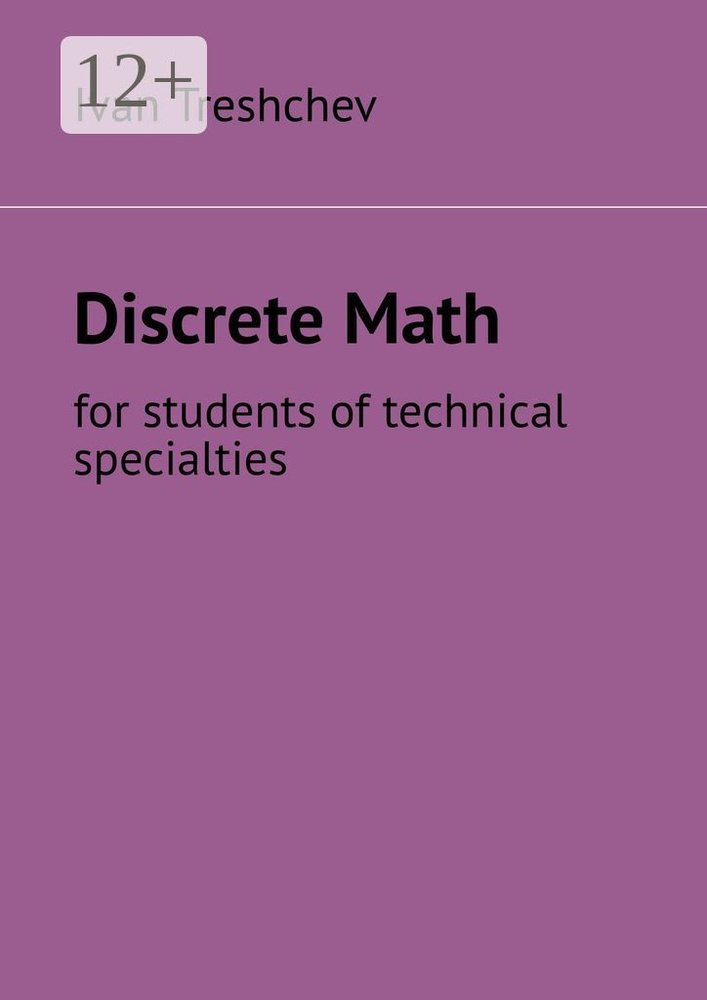
Discrete Math. For students of technical specialties
Тип книги:
Печать по требованию
О товаре
Перейти к описанию
Автор на обложке
Ivan Treshchev
Год выпуска
2020
Тип обложки
Мягкая обложка
Тип книги
Печать по требованию
Язык издания
Английский
О книге
Черно-белая книга в цветной мягкой обложке.
Книга изготавливается по технологии “печать по требованию”. Срок печати 96 часов.
The manual is intended for students of the specialty information securit
Товар закончился
1 897 ₽
Нет в наличии
Магазин
Подписаться
Ridero
Перейти
4.8
Чат
Заказы
309 K
О магазине
Часто задаваемые вопросы
Описание
Черно-белая книга в цветной мягкой обложке.
Книга изготавливается по технологии “печать по требованию”. Срок печати 96 часов.
The manual is intended for students of the specialty information security of automated systems when studying the course “Discrete mathematics”, and can also be used by students of other specialties studying similar courses.
The author would like to express gratitude to his supervisor A. Khusainov and Mikhailova N.N.
Оглавление
Introduction
1. PLURALITY
- 1.1. Definitions and examples
- 1.2. Ways to Define Sets
- 1.3. Set Operations
- 1.4. Set Operations Properties
- 1.5. Euler-Venn Diagrams
- 1.6. Characteristic functions
- 1.7. Relationships
- 1.8. Functions
- 1.9. Algebraic operations
- 1.10. Hasse diagrams
- 1.11. Theorem
- 1.12. Algebraic structure
- 1.13. Theory
- 1.14. Algebras with one operation (semigroups)
- 1.15. Algebra with two operations two operations
- 1.16. Vector spaces
- 1.17. Modular arithmetic
- 1.18. Commutative semiring
- 1.19. Group
- 1.20. Boolean functions
- 1.21. Equivalent formulas
- 1.22. Algebra of Boolean functions
- 1.23. The principle of duality
- 1.24. Perfect normal forms
- 1.25. Closed classes of Boolean functions
- 1.26. Completeness of a system of Boolean functions
2. COMBINATORY
- 2.1. The basic principles of combinatorics
- 2.2. Placements
- 2.3. Combinations
- 2.4. Number of permutations
- 2.5. Inclusion and exclusion formula (main theorem)
- 2.6. The concept of a lattice, a distributive lattice
- 2.7. The principle of mathematical induction
- 2.8. The Cantor diagonal method
- 2.9. The principle of transfinite induction
- 2.10. Newton’s binomial
- 2.11. The Dirichlet Principle
- 2.12. FermatSmall Theorem
- 2.13. Chinese remainder theorem
- 2.14. Prufer Code
- 2.15. Fibonacci
- 2.16. Bene formula
- 2.17. Euclidean Lemma
- 2.18. Stirling numbers
- 2.19. Bell Number
- 2.20. Generating functions
- 2.21. Generalized recurrence relations
- 2.22. Zhegalkin polynomial
- 2.23. The problem of Hanoi towers
- 2.24. The general problem of sticker stamps
- 2.25. Return search method
- 2.26. full search
3. GRAPH THEORY
- 3.1. Simple graphs and their properties
- 3.2. Metric spaces
- 3.3. Trees and forest
- 3.4. Eulerian graphs
- 3.5. Parts Count
- 3.6. Hamiltonian graphs
- 3.7. Graph operations
- 3.8. Incidence matrix
- 3.9. Chromatic number of a graph
- 3.10. Five-color theorem
- 3.11. Flat graphs
- 3.12. Counts of Kuratovsky
- 3.13. Platonic solids
- 3.14. Mobius function
- 3.15. Adjacency matrix
- 3.16. Inversion formula
- 3.17. Product
- 3.18. Cyclomatic number of a graph
- 3.19. Independence and coverings
- 3.20. Dominant sets
- 3.21. Dijkstra’s
- 3.22. Kruskal (Kruskal) Algorithm
- 3.23. Prima Algorithm
- 3.24. Bipartite graphs and matching
- 3.25. Transport networks
- 3.26. The problem of finding a spanning tree of minimum weight
4. ENCODING AND MATHEMATICAL MODELING
- 4.1. Encoding
- 4.2. Alphabetical encoding
- 4.3. Coding with minimal redundancy
- 4.4. Noise-tolerant coding
- 4.5. Code distance (Hamming distance)
- 4.6. Separable schemes
- 4.7. Prefix schemes
- 4.8. Macmillan Inequality
- 4.9. Automata
5. Examples of execution
- 5.1. Tasks for an independent solution
6. Examples of calculation and graphic tasks
- 6.1. Settlement and graphic work 1
- 6.2. Settlement and graphic work 2
- 6.3. Settlement and graphic work 3
CONCLUSION
List of references
- Артикул
- 176850877
- Автор на обложке
- Ivan Treshchev
- Год выпуска
- 2020
- Тип обложки
- Мягкая обложка
- Тип книги
- Печать по требованию
- Язык издания
- Английский
- Количество страниц
- 254
- ISBN
- 978-5-4498-7601-0
- Возрастные ограничения
- 12+
- Документы качества:
- Товар не подлежит обязательной сертификации
Подборки товаров в категории Научная и научно-популярная литература
Отзывы о товаре
0
Discrete Math. For students of technical specialties
Рейтинга пока нет. Он формируется на основе актуальных отзывов на заказанные и оплаченные товары
Как правильно задавать вопросы?
Будьте вежливы и спрашивайте о товаре, на карточке которого вы находитесь
Если вы обнаружили ошибку в описанием товара, воспользуйтесь функцией
Как отвечать на вопросы?
Отвечать на вопросы могут клиенты, купившие товар, и официальные представители.
Выбрать «Лучший ответ» может только автор вопроса, если именно этот ответ ему помог.